



A year after President Trump’s return to office, a federal shift in vaccine recommendations was implemented, fueling a divide in trust, science and personal choice while local health professionals are being forced to adapt quickly.
“I would say in the last 20 years there haven’t been as many changes as I have noticed within the last year and a half,” Dr. Sarah Smith, family medicine physician at Avera Medical Group in Brookings, said when asked if the changes in vaccine protocols have seemed “big” or “typical” compared to changes made by past presidential administrations.
On Jan. 5, a news release from the U.S. Department of Health and Human Services informed citizens that different recommendations for childhood immunization schedules in the U.S. are being implemented.
This change came one month after Trump’s memorandum to the HHS and Centers for Disease Control and Prevention titled “Aligning United States Core Childhood Vaccine Recommendations with Best Practices from Peer, Developed Countries.” The president compared the United States’s 18 recommended vaccinations to Japan, Denmark and Germany, who recommend less.
According to the memorandum, Denmark recommends vaccinations for 10 diseases with serious morbidity or mortality risks, Japan recommends vaccinations for 14 diseases and Germany recommends vaccinations for 15 diseases.
Trump said this makes “our country a high outlier in the number of vaccinations recommended for all children,” according to the memorandum.
While the changed framework makes different recommendations for families, according to the HHS release, it does not enforce any rules or laws against or for specific vaccinations. The changes “promote individualized decisions based on risk.”
The CDC’s childhood immunization schedule will still be categorized the same. All of the categories will still require insurance companies to cover the vaccinations without cost-sharing because of the Affordable Care Act.
“This new schedule ensures that all vaccines that are covered by the previous (vaccination) schedule will still be available to anyone who wants them,” Nayeema Ahmed, immunization program director at the South Dakota Department of Health, said. “Access is not an issue under this new recommendation.”
According to Smith, Avera Medical Group and Sanford Health now follow the American Academy of Pediatrics for vaccine guidelines.
“So the American Academy of Pediatrics has kind of taken over where the CDC has made changes,” Smith said.
The CDC recommends two doses of the measles vaccine, with the first being given at 12-15 months old, and the second at 4 to 6 years old. Among the changes, Smith said measles is a disease that is of more concern now than in previous years. As of early March, she said there’s been over 1,000 measles cases in the U.S.
“We know that one in five people who get measles will be hospitalized,” Smith said.
She also said people that have one vaccine are 95% protected from the disease. She explained the measles vaccine is one where a follow-up booster is recommended.
In regard to the changes in recommendations, Smith said it’s frustrating and she thinks there’s a “climate of doubt right now.”
“The vaccine recommendations were vetted and were studied extensively, you know, found to be safe and effective … I think there’s a lot of people who kind of doubt the validity or maybe they don’t have a good relationship with someone in medicine or maybe had a bad experience … we’ve seen an erosion of trust,” Smith said.
‘Talk to your medical doctor’
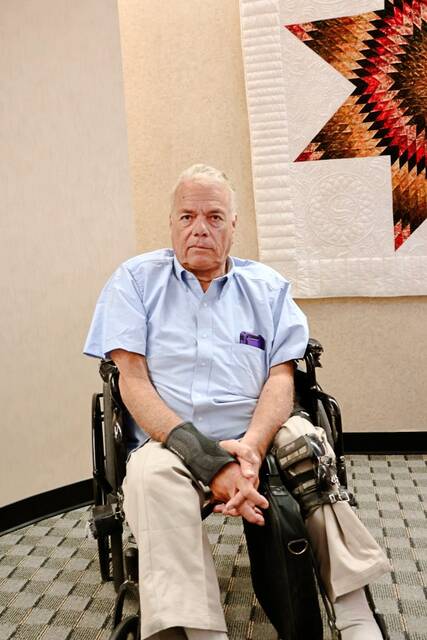
Mark Sternhagen, a Brookings resident and polio survivor, echoed this sentiment.
Sternhagen developed polio when he was 18 months old, and the disease paralyzed him from the waist down.
Sternhagen explained that when his siblings received the vaccine in 1956, he had a fever and the protocol at the time prohibited vaccines from being administered to individuals with a fever.
Sternhagen is now a vaccine advocate, and is the author of two books, one called “Understanding Rhythm,” and “Normal for Me.” The books highlight his life and beliefs in vaccine benefits.
Sternhagen encourages people to “talk to your medical doctor.” He brought up scenarios in which people might listen to “Dr. YouTube” instead of their real doctors and end up with their child having an infectious disease.
“It’s become political, and it shouldn’t be. It’s a health thing, not a political thing,” Sternhagen said.
Smith echoed this, saying: “Multiple large-scale studies have demonstrated no association between vaccines and Autism. Double blinded studies are routinely used to evaluate vaccines, safety and efficacy. If you have any questions about any vaccine, talk to your medical doctor.”
To learn more about vaccine safety, Smith recommends reading a systematic review from The Lancet called “The State of Vaccine Safety Science: Systematic Reviews of the Evidence,” or “The Vaccine-Hesitant Moment,” a study done by the New England Journal of Medicine.
Chiropractor shares her joy over increased vaccination discussion
Dr. Tricia Schwartz-Smith, chiropractor at Natural Arts Chiropractic & Acupuncture, has a different view of recent changes to vaccine recommendations. She said she had “a leap of joy” after the Trump Administration’s changes in recommendations because it “prompted honest discussions and shined a light on this topic.”
“I knew about the Henry Ford study of which they brought to Congress and reviewed,” Schwartz-Smith said. “When they made those changes, I was like, ‘at last,’ you know, it’s OK to ask questions.”
The “Henry Ford study” that Schwartz refers to is the main topic of a documentary called “An Inconvenient Study.” The documentary was produced by the Informed Consent Action Network and executively produced by ICAN’s CEO, Del Bigtree, a former journalist and television producer.
“An Inconvenient Study” explores a study done by Henry Ford Health comparing vaccinated and unvaccinated children and addresses the debates surrounding vaccine safety, chronic illness and transparency in public health research.
Schwartz-Smith also brought up vaccination history. Former president Ronald Reagan’s National Childhood Vaccine Injury Act of 1986 created a “no fault” system for compensating vaccine related injuries or deaths, and its purpose was to ensure a stable market supply of vaccines.
Schwartz-Smith said this prompted more vaccines, and less research.
“They (the companies making vaccines after the National Childhood Vaccine Injury Act was passed) didn’t do double blinded studies to prove that any of their vaccinations were safe or effective,” Schwartz-Smith said.
Also after the act was passed, Schwartz said this is when there was a rise in chronic childhood health conditions.
Schwartz-Smith said this does not imply that she thinks “nobody should vaccinate ever.” She said the National Childhood Vaccine Injury Act decreased the overall questioning around vaccine accuracy and efficacy and doesn’t think talking about or questioning vaccinations should be taboo.
She said every parent should be able to make the decision on whether to vaccinate their own children, but said the problem is most parents don’t take the time to do their own research.
“They’re (parents) tired, they’re sleep deprived, they’re just following doctors’ orders,” Schwartz-Smith said.
Schwartz-Smith recommends parents to review vaccine inserts, a document required by the U.S. Food and Drug Administration for vaccine packaging. The inserts outline ingredients, dosage, clinical trial data and reported side effects.
She also mentioned the use of pay-for-performance. According to the National Library of Medicine, “P4P refers to the use of financial incentives to stimulate improvements in health care efficiency and quality.”
The NLM cited an example from Hudson Health Plan, where a $200 bonus payment was given for each fully immunized 2-year-old.
“They should just be doing their job, cause they’re looking out for the health and wellness of that individual,” Schwartz-Smith said regarding P4P’s for immunizations.
Leave a Reply