
BROOKINGS — If there’s a board facing a no-win situation right now, it’s probably the Brookings County Drainage Board as it weighs a decision on whether to re-establish a dike on the Big Sioux River in Medary Township.
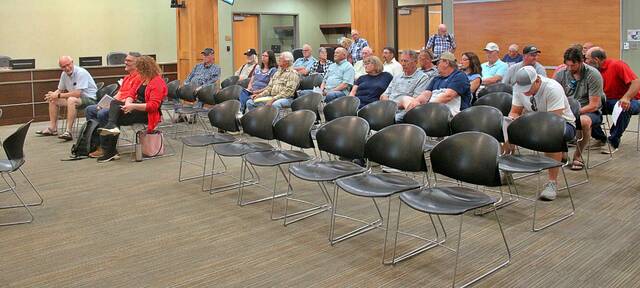
That much was evident at the board’s June 8 meeting where Brookings-based Banner & Associates presented a draft environmental assessment to a room filled with concerned residents and landowners. While some supported the dike’s restoration, others were hesitant or opposed to any such move.
The dike protected the entrance to a diversion ditch that has existed since at least the 1960s, according to the assessment. It slowly eroded over the years, with more river water flowing into the ditch to the point that, since 2011, up to 70% of the Big Sioux River’s water goes into the ditch rather than staying in the main river channel, especially during flooding periods.
This change in the area’s hydrology has flooded farmland, increased erosion and threatened infrastructure, including the bridge on 216th Street — also known as County Road 12 and the Sinai Road — that crosses the now-larger diversion ditch.
Re-establishing the dike, though, is no simple proposition. It’s on land just north of 416th Street and west of the river that has a wetland easement via the federal Natural Resources Conservation Service. Other agencies would be involved, too, including the U.S. Army Corps of Engineers and the South Dakota Department Agriculture and Natural Resources.
All those hurdles would be moot, though, if the drainage board decides not to move ahead with the dike’s restoration — a decision that hasn’t been reached yet. With that in mind, two scenarios were included with the assessment:
Alternative 1: No action
The dike would not be rebuilt. The Big Sioux River would continue its current flow pattern with increasing volumes entering the diversion ditch.
Reasonably foreseeable effects would include:
• Continued and increasing flooding of agricultural land.
• Ongoing erosion and channel migration.
• Progressive infrastructure damage and rising repair costs.
• Increased financial burden on Brookings County and Medary Township taxpayers.
Further details were also provided regarding the potential financial impact regarding infrastructure:
• 216th Street bridge: Sitting west of the main Big Sioux River bridge, this structure is 117 feet long and would need to be replaced with a 212-foot bridge at a cost of between $3.3 million to $4 million.
• 217th Street culverts: There would be a need for up to 40 culverts at 72 inches apiece, along with raising the street’s grade to 1,580 feet. Total estimated cost ranges between $1.2 million and $1.45 million.
• 469th Street/County Road 19 bridge: The current structure is 112.5 feet long and would need to be replaced with a 212-foot bridge at a cost estimated between $3.3 million and $4 million.
Altogether, taxpayers in the county could face costs between $7.8 million and $12.45 million in the years ahead if the dike isn’t restored.
Alternative 2: Proposed action
This approach leads to the reconstruction of the dike at the confluence of the Big Sioux River and the diversion ditch. It would:
• Restore majority of flow to the main channel, diverting only a small amount for downstream livestock use.
• Requires temporary subordination of NRCS wetland easement.
• Section 404 Permit from the Corps of Engineers for fill activities in river and wetlands.
• Cost is estimated to be about $301,000, with funding provided by the county.
Audience concerns
While the numbers provide precise information, they don’t always tell the whole story — specifically, its human element. Of the crowd at the June 8 meeting, 14 testified before the drainage board. Here’s a sample of what they had to say:
• Steve Wicks is a Nunda-area farmer who owns 310 acres or so of land north of Lake Campbell.
“We used to raise crops down there, but we haven’t done anything since (2004). … We’re not getting any value out of that property and we’re getting taxed for good ground (that’s under water),” he said. “We’re in favor of having that dike put in because it’s not doing us any good — we’ve got 240 acres we can’t even sell; it’s worthless. Last year, it flooded four times. If Estelline and Castlewood get another 3, 4 inches, it’ll flood again. I’m in favor of it and there’s a lot of people probably thinking the same way. We can’t even keep fence, we can’t raise cattle down there, we can’t do a thing down there.”
• Sean Lesnar lives near the Big Sioux River on its east side.
“Even if you fix that dike … it’s still going to go around it in high-water times,” he said. “I’ve lived there 26 years and never past, really, mid-May, end of May, did I worry about flooding. It’s flooding all the time now. Last July, my entire property was under water.”
He said even now his property is flooding, and it’s not even near the dike.
“It’s not a dike problem to me. There’s a lot of water going into that river, and I’m not an expert on it … people want to whisper about it, but in my opinion, all the drain tile that’s been put in over the years, and the city’s development — and I’m not complaining about it — it’s just that, the physics of water, the water’s getting there 10 times faster.”
• DJ Reker lives near Lesnar and worries that if the dike is restored, the resulting increase in water levels on the river could threaten upward of 20 homes just east of the river.
He said he’s an outdoors person who enjoys fishing, kayaking and hunting who also sympathizes with the plight some farmers are facing, but that priority should be given to the family homes near the river.
Board insights
The drainage board — comprised of Larry Jensen, Shawn Hostler, Kelly VanderWal, Doug Post and Dave Miller — had questions and comments as well. These included:
• Post inquired about the effects of bridge scouring — the erosion of soil around a bridge’s foundation caused by swiftly moving water — and learned it could eat away at the foundation under the concrete support pillars and can also reach into the bridge’s back walls, which can lead to an abutment failure. In a worst-case scenario, scour can lead to the total loss of a bridge. It’s been an issue with bridges over the drainage ditch for some time now because of the increased water flow through it.
He also had financial concerns that might arise from the accumulation of sediment in the main river channel in the years since the dike fell into disrepair due to a weaker river current. The sediment’s presence might keep that channel from being able to efficiently handle the additional flow of water if the dike is fixed — at least until the now-stronger current could reduce the sedimentation.
Until that occurs, Post feels it could raise the risk of flooding in the area of the main channel, which might mean the county would eventually have to find a way to pay for costs not envisioned in the June 8 draft environmental assessment.
• Miller’s perspective focused on the proposed project’s primary goal.
“One thing I want to really clarify is that this dike — none of this conversation is to solve flooding issues,” he said. “None of this. Not one part of this is to control flooding. It’s simply to redirect that water from the diversion channel back to the main channel so that the water can flow better through there. And, on the back side of that, to keep the (216th Street) bridge from eroding away and that we have to repair that at some time.”
• In closing, VanderWal thanked the crowd for coming to the meeting.
“I really appreciate this feedback. As commissioners, we’ve got some more questions to ask Banner — we’re going to be in talks with them to better understand this,” he said.
— Contact Mondell Keck at [email protected].
Leave a Reply