
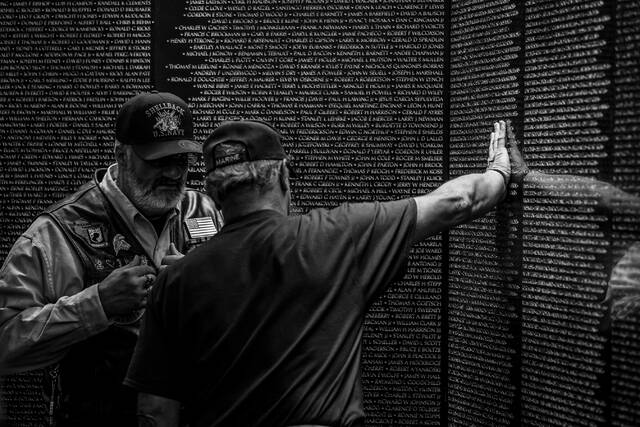
BROOKINGS –– Over the course of its 250-year history, the United States of America has paid tribute to those men and women who served their nation in uniform –– and has especially honored with memorials those men and women who died in uniform: the Vietnam Veterans Memorial –– The Wall –– honors those 58,281 men and women who did not return home from that war.
Now South Dakota veterans who served in Vietnam and returned home but later died as a result of their time there are being honored with The Wall That Heals, a three-quarter scale replica of the Vietnam Veterans Memorial –– The Wall –– in Washington, D.C. The Wall That Heals will be on display at the Fishback Soccer Complex in Brookings on June 11-14. There will be no charge for visiting the exhibit. This is its only stop in South Dakota this year.
The Wall That Heals brings an opportunity to recognize those servicemen and servicewomen who years after their service in Vietnam suffered the effects of exposure to Agent Orange, PTSD (post-traumatic stress disorder) and other debilitating illnesses tied to their service.
SCHEDULE OF EVENTS
June 9
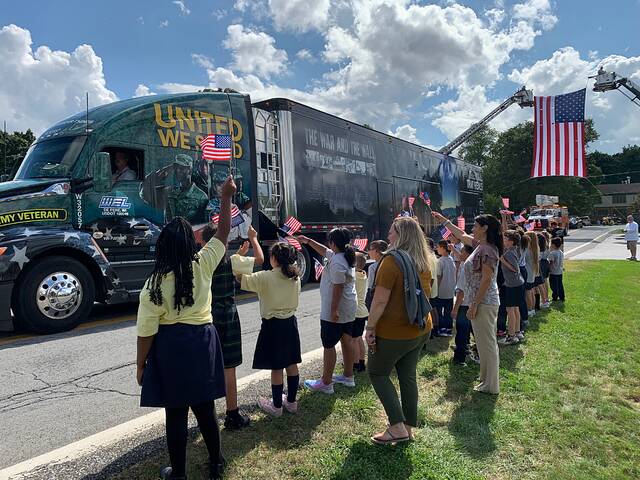
• 1 p.m.: The Wall arrives in Brookings. The public is encouraged to help welcome The Wall That Heals motorcade escort to Brookings. The Rolling Thunder Chapter 2 of Brookings will escort the motorcade.
June 10
• Set up begins at 8:30 a.m. People are welcome to volunteer to help.
June 11
• 9 a.m.: Welcome Home Ceremony.
June 12
• 9:45 p.m.: Light the Night in teal for PTSD Awareness Month
• The Wall available for viewing 24 hours.
June 13
• No special events. The Wall available for viewing 24 hours.
June 14
• 1:30 p.m.: Closing ceremony
• 1:58 p.m.: Final Taps
• 2 p.m.: Disassembly begins
Taps at sunset daily.
Leading the effort to identify those South Dakota men and women and women cited above is Kristin Zimmerman, director of Brookings Parks, Recreation and Forestry Department, who has been leading the local “The Wall That Heals” committee.
“As our nation celebrates its 250th birthday this year, Brookings is humbled to serve as a place of remembrance and honoring our Vietnam veterans,” the director said. She added that The Wall That Heals has special meaning to her: “I’m a military child, born and raised. My grandfather was in the Korean War; my dad was in Operation Storm and all other conflicts in between.”
Additionally, Zimmerman is looking for volunteers to help with a variety of duties needed while The Wall That Heals is in Brookings. Among those responding to the call to serve are three veterans: Working a late shift, 10 p.m. to 2 a.m. is Jeff West. “I was a bit late getting on the volunteer list and there weren’t a lot of shifts left. But if there’s other work to be done, I’ll help out. I’ll be there during the day.”
He has visited both the Vietnam Veterans Memorial, in Washington, D.C., and The Wall That Heals, when the traveling replica was in Kansas City, Kansas.
West, 78, was in Vietnam 57 years ago as a combat infantryman and returned home in De3cember 1969. He noted that his first visit to the Memorial, in 1998, “was really very, very difficult for me. It’s devastating. All those things that you have suppressed for years come to the surface. And then you’ve got to deal with them. It’s the beginning of the healing process.” When he visited The Wall That Heals, he found it easier than his first visit to the Memorial.
“That second visit helped change my feelings about The Wall (in Washington),” he explained. “When it was built, they called it ‘a scar upon the land.’ I felt that was perfect because the Vietnam War was a scar upon our country.
“But my feelings have changed about it. Now I think The Wall is a beautiful thing. I’m glad we have (The Wall That Heals) so many more people can experience the impact of 58,281 names. It’s very impactful for everybody. They realize how big the sacrifice was.”
Philip Egeberg served four years, 1984 to 1988, on active duty in the Marine Corps; two years in the inactive South Dakota Army National Guard; and 14 years in the South Dakota Air National Guard. In the Air Guard, he served 90 days in Afghanistan. ‘I volunteered for 6 a.m. to 10 a.m. on Sunday to help visitors at (The Wall That Heals). I also took vacation on Wednesday to help set up The Wall and I’m going to come back on Sunday and help them take it down.”
“This is important to me because I had two uncles who served on active duty in Vietnam, both of them in the Army.” Additionally, he has family members who have served in uniform “since the Civil War.” That roster of many relatives who served over many years greatly influenced him to volunteer and serve.
“It’s something I always wanted to do,” Egeberg said. “You grow up with uncles you look up to and admire. My great uncle Lawrence was a a medic in World War II ; great uncle Clarence was a tanker in Normandy in France.” Another relative was a prisoner-of-war in the Philippines. Finally, he remembers a relative “who served in the cavalry in World War II, went to Korea and later was called back in the early days of Vietnam.”
John Hittle, also a former Marine, served four years on active duty, 1980 to 1984, and two in the inactive reserve. After some time away, he would go on to serve in and retire from the South Dakota Army National Guard, with a combined total of more than 20 years of military service.
“I’m going to be helping at The Wall (That Heals),” Hittle said of the duty he volunteered for. “The reason I wanted to do that –– you were able to volunteer for where you wanted to work, and you still can –– I just thought I’d be better out there.”
Hittle has been to the Vietnam Veterans Memorial in Washington twice and was moved by that experience. He has also been moved by meeting a couple of former Marines who had served in Vietnam and were experiencing severe symptoms of what today would likely be diagnosed as PTSD (post-traumatic stress disorder).
“I don’t want people to forget Vietnam,” he said. “It wasn’t a popular war. Should we have been there? I don’t know. … A lot of people there didn’t come home. And The Wall (That Heals) is a great honor for them and everybody has a chance to go see it. And when you have a chance to volunteer for something like this, you have to take that chance. … This is something I’ve got to do.”
Zimmerman is still looking for a few good men and women to step up and volunteer: Go to https://www.cityofrbrookings-sd.gov/913/volunteer.
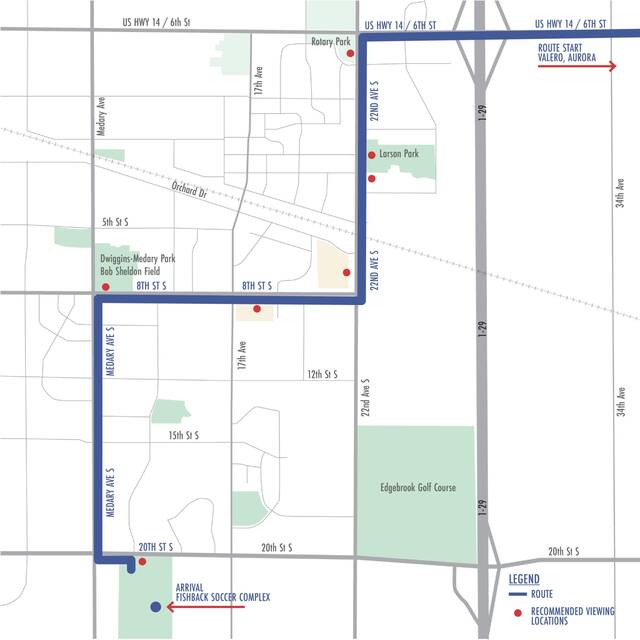
Motorcade route
• Start at 1 p.m. at Valero Renewables Plant in Aurora.
• Travel west on U.S. Highway 14 into Brookings.
• At the Sixth Street and 22nd Avenue intersection, turn south onto 22nd Avenue.
• Turn west onto Eighth Street South.
• Turn south onto Medary Avenue.
• Arrive at Fishback Soccer Complex.
Motorcade viewing areas
The public viewing areas — where the city will have buckets of small flags for the public to wave — are:
• Rotary Park at the Sixth Street and 22nd Avenue intersection.
• Larson Park along 22nd Avenue.
• Brookings Radio Station along 22nd Avenue.
• Hy-Vee’s east parking lots along 22nd Avenue.
• St. Thomas More Catholic Church – north side.
• Dwiggins-Medary Park, near baseball fields along Eighth Street South, near Medary Avenue (or you can say near Bob Shelden Field).
• Fishback Soccer Complex.
Event details
• Host: Brookings Parks, Recreation and Forestry Department.
• For: All ages.
• Open: 24 hours from morning of June 11 until 2 p.m. June 14 (Flag Day).
• Cost: Free.
• Tours: Guided group tours available upon request. Visit www.cityofbrookings-sd.gov/TheWallThatHealsBrookings2026.
— Contact John Kubal at [email protected].
Leave a Reply