
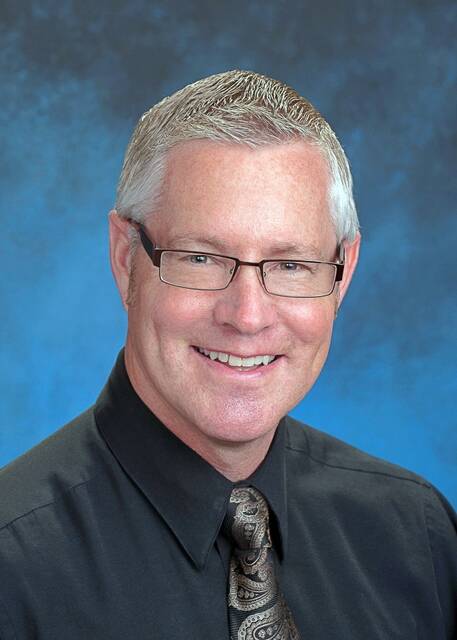
BROOKINGS — For 15 years, the Rev. Gregg TeBeest, 65, has served as chaplain for the Brookings Health System. A major role of his chaplaincy is hospice care: it demands helping a patient face end of life issues, spiritual and emotional, and helping them make end of life decisions. It also involves helping family members face death: “Absolutely,” the chaplain said. “The end of life is a journey for the whole family.”
TeBeest noted that he must be able to minister to people of all faiths, or of no faith: “Spirituality is really all encompassing. Whether people realize it or not, there’s a spiritual aspect to their lives, which is apart from religion: it really goes to a person’s sense of meaning, what gives their life purpose and that’s what we focus on.”
He recently earned a Doctor of Theology (DTh) in Thanatology, Online from Capstone University. The non-denominational course of studies took seven years to complete. He had nine required graduate doctorate-level courses in thanatology plus his doctoral dissertation: “The theology of medical aid and dying: attitudes made among nurses in a rural South Dakota hospice setting where it is not legal.”
TeBeest explained that thanatology is “basically a study of death and dying. … It’s a holistic discipline. That means it addresses physical, psychosocial, spiritual, and biomedical aspects, especially in dealing with human mortality. Thanatology is a discipline instrumental in providing a framework for education for a period of bereavement, hospice care, palliative care and end of life education, too. That’s what the focus of it is.”
He calls it “really special, for members of the hospice team to be allowed into a family situation and a patient’s end of life is sacred. It’s really a privilege for me to be able to be allowed in to serva as a minister to a patient and their family at such poignant moment in their lives.”
“There are hospice houses; there is no hospice house in Brooking,” the chaplain explained. He then explained: “It’s a faulty misconception that hospice is a place where people go to die. It’s really about having a dedicated, interdisciplinary team that’s working on behalf of the patient and their family. To provide end-of-life care. “Comfort care is the focus of hospice.” And hospice demands a team approach: People working behind the scenes: pharmacist, physician director and others, such as a chaplain
“(Hospice) philosophy also aims to keep the patient in their home as long as possible,” TeBeest said. “However, sometimes that isn’t possible. It could be a nursing home, long-term care facility, and sometimes in hospital or wherever the patient happens to be.”
Hospice can begin with a six-month terminal diagnosis. Death, however, is not a certainty. “We’ve had patients over the years who have gone into hospice and graduated,” the chaplain added.
“Acceptance of death is personal and unique,” he noted. “All have different approaches to their lives in general. And then when it comes to that point in their life where they’re facing terminal illness or the death and dying process, oftentimes I find that they’ll draw on their own resources for how to cope.”
A death-denying culture
“It’s about medically assisted dying,” TeBeest said, exploring one of the elements that may end hospice care. “It takes place when a patient has a terminal diagnosis and they choose to die by self-administered injection. In other words, a doctor diagnoses a patient and says that they have six months or less to live.
“Medically assisted dying is legal in 13 states and the District of Columbia. Eleven more states have considered legalizing it in 2026. Iowa and Minnesota are among them.” The South Dakota Legislature has taken no action relative to medically assisted dying.
TeBeest’s doctoral study “explored how religion, personal faith, ethics and ideology shaped nurses’ attitudes toward medically assisted dying in South Dakota.” Participating hospice nurses came from the Brookings Health System and Prairie Lakes Healthcare System in Watertown.
TeBeest pointed out that there is a difference between “patient-administered medically assisted dying” and “physician-administered medically assisted dying.” In the first instance, the patient must self-administer the medication. The physician cannot administer the lethal dose of medication.
“In other words, come to the end of all things, the patient chooses to die by medical assistance: The doctor prescribes the medication, gives it to the patient and the patient drinks the medication. … Physician-administered dying is illegal in the United States, but legal in other jurisdictions, like Canada and Europe.”
TeBeest’s study showed that: “… 100 percent of nurses surveyed agreed that patients should have the right to choose medically assisted dying but none of them said it should be legalized in South Dakota.”
“I think there is death-denial in our culture,” DeBeest said. “All you have to do is look at the media and what they promote in terms of personal healthcare and longevity and all those things are pretty much forced on people in our culture.
“Like I said before, many people don’t really think about mortality to the degree that they should. It’s not something that we can put off forever; so, I think there is a challenge there. When a person enters hospice care, they think about it whether they want to or not.”
For a lot of people, faith is what helps them cope. For people who don’t have faith, they draw upon their own resources. You’d maybe expect fear would be a component; but I haven’t often found that with people.
“They’re not so afraid of dying as they are about the process of dying. So they wonder what their death will look like: if they’ll suffer; will they have pain; how will their family will manage and cope, those types of things. As far as death itself, that’s not a major concern for most people. They’re really concerned with their family, about being a burden.”
In summation, TeBeest explained: “My interest in thanatology is kind of academic. It does dovetail nicely into my work as a hospice chaplain; but as far as my work is concerned, I’m a pastor first and foremost. That’s my passion and that’s my calling. That’s what my work is all about. I am blessed in my healthcare ministry, and I wouldn’t trade it for anything.”
— Contact John Kubal at [email protected].

Leave a Reply