
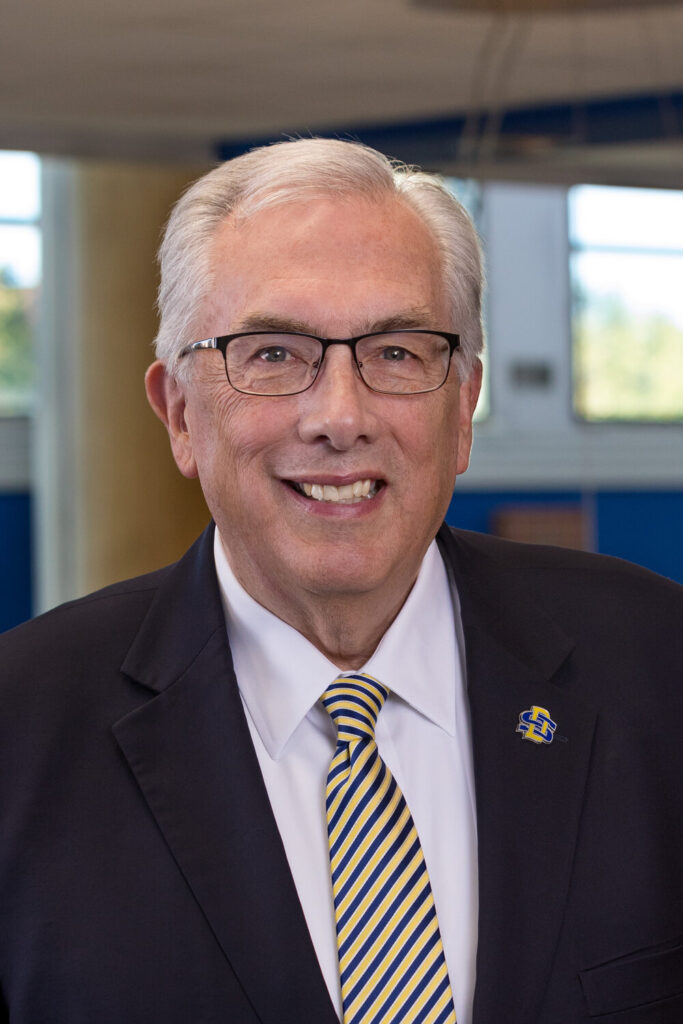
BROOKINGS Imagining our Future was the title of the inaugural speech of Barry Dunn, incoming president of South Dakota State University, on Sept. 29, 2016. He honed in on a theme of Imagination, bringing with it his vision for a land-grant universitys core values: access; altruism; and aspiration. That future has become today.
As he begins his ninth year as president, how much of what he imagined came to pass? And what is his present focus on? On Thursday, the president met with The Brookings Register in his campus office and took a look back to then, at now and ahead.
The president began with a look at a key pursuit in Pathway to Premier 2030, SDSUs current seven-year strategic plan: R1 status, a Carnegie Classification, which he explained, is an independent rating of a universitys research capacity and productivity.
Its important, Dunn explained. We are an R2 university; we have a certain level of spending and we graduate a certain number of students with Ph.Ds every year. To be an R1, its a status symbol but its more importantly a reflection of your universitys impact on the economic development and vitality of the region, certainly our state. For us, were kind of regional.
So we set a goal in our last strategic plan to be an R1 university. There are two classifications: one of them is the number of dollars that are generated each year in research expenditures; and we exceed that metric by quite a bit.
The second is the number of Ph.D degrees that you award; we are under that. The requirement is 70 and were more in the 40 to 50 range. So we have to increase the number of Ph.D degrees we award each year.
We continue to increase our research expenditures; were $11 million over a year ago. We were $84 million last year; the year before was $73 million..
Weve increased our enrollment of Ph.D students; youve got to get them in here to get them out of here. Weve got a ways to go. Were excited about it and working hard to do that.
The president noted that R1 status is usually sought after but it has not been a focal point for South Dakota, which is one of only five states that do not have an R1 university. The other four are Alaska, Idaho, Wyoming and Vermont.
Dunn admitted that it will take awhile to attain R1 status. It could be the end of this decade before we get there, but were working on it.
He also noted that in the case of South Dakota, attaining R1 status is tied to the universitys land-grant mission. There are 140 R1 universities; in that number all the big land grants are R1s.
Wokini is a program that (SDSU) started, Dunn said, in response to a question about a program unique to SDSU. The defining character is that we as as a land-grant universiry, with the enabling act of statehood, South Dakota State College then received 140,000 acres of land. Thats how Lincoln envisioned paying for the land-grant universities.
Were the only university that has used the resources from that land to help specifically in a very public way, we are the only land-grant university who has dedicated the funds that flow from that land, which is held in trust for us, to help the indigenous people of our state. Its pretty unique.
Other states have done other things. Many states now provide free tuition to indigenous tribal people: Montana, Colorado, Oklahoma and Minnesota.
Its a really nice thing. We dont do that. But our Wokini Initiative provides a very large scholarship; so it helps toward the cost of education.
A look at land-grant history
The Morrill Act, which brought the land grant universities to life, looked to a focus on agricultural and mechanical arts. How does the land-grant mission today, in the digital information age, meld into the land-grant mission as it came into being in 1862?
I think it does have to be, Dunn said. But most land grant universities are very, very broad in their mission. I think the mission has expanded over time as the economy has changed.
The president is well-versed in the history of the land-grant university system and harked back to its genesis: Lincoln and certainly those around him anticipated that they would win the Civil War. And they anticipated that following the war there would be an industrial revolution. And to feed an industrial revolution you needed increased agricultural activity.
Dunn explained that prior to the land-grant system higher education was restricted to the elite and white men. (The land-grant system) was revolutionary and it really tied back to Horace Mann, the father of public education in America. It was revolutionary in the history of man that youd have public education, let alone higher public education.
Continuing, the president added that Lincoln and others, Justin Morrill, knew that they couldnt generate enough engineers, and you couldnt generate enough ingenuity to build bridges and build factories with just having it in the hands of the elite at Harvard, Yale, Duke, Penn and the really elite schools at the time. Pretty impactful legislation.
Better prepared, focused
So what is a freshman student entering SDSU today in Dunns presidency as compared to a typical student entering SDSU when he took the helm in 2016?
I believe our student body is better prepared today they were 8 years ago when I started, he said. Lots of students come with dual-credit and AP (advance placement) credit. And I do think that has influenced a lot of young people and got them engaged. I think theyre more focused on an outcome than Im not sure about eight years ago but certainly 20 or 30 years ago, Theyre very focused on graduating; theyre very focused on a career in pharmacy, or nursing, or getting into med school or into engineering. In brief: theyre better prepared and better focused.
Add to that a getting them to SDSU and keeping them here and on the path to graduation: Harking back to his days as college dean at SDSU, the retention rate was in the low 70s, not uncommon for public colleges and universities. In private, more elite schools, its in the 90s.
Thanks to academic coaching and counseling, SDSUs retention rate is in the low 80s and will be higher than it was last year. Were very, very excited and very proud of that. Its extremely unusual to have freshmen retention rates as high as ours will be this fall. Thats a great thing.
While it will be awhile before the numbers are locked in, Dunn noted that enrollment will be very high this fall. Here I am in my ninth year. We went down in enrollment; now were going back up in enrollment. Thats great.
Dunns get-it-done list
Asked about a must-get-done list, the president cited gaining accreditation for some of the universitys academic programs, one of them being the Ness School of Management and Economics.
Thats a really big, big step for us, he said. It was a goal for President Emeritus (David) Chicoine (Dunns predessor). Its hard. We invested a lot. Larry and Diane Ness provided a wonderful gift to us, endowed a lot of money that can flow into that school and help us be successful. I think the culmination of that will be accreditation of that program as a business school. (The accrediting agent in this instance is the Association to Advance Collegiate Schools of Business.
Weve got to get that done. Weve got so many students in those programs and we want to be able to say that our accounting program, our economics programs are equal to or better than others. Thats what that accreditation gives us. Thats very, very important to me.
Also important to Dunn are basic, but not especially glamorous, projects tied to the general upkeep, maintenance, repair and physical appearance of the campus.
Stewardship of our resources is really important to me, Dunn said. Im not going to be president forever. When I leave, I want the campus to be in really good shape: both financially, which we are, but also physically. Thats kind of whats important to me right now.
Safe campus, safe community
Finally, asked about SDSUs relationship town and gown with the City of Brookings, Dunn called it really great. He noted that recently SDSU was ranked one of the safest campuses in the United States. Thats a great achievement. That success of having a very safe campus reflects a very safe community.
He recently attended a meeting of the Brookings City Council and expressed his thanks for the citys great police force, the lighting of city streets.
We together have a very safe campus community in Brookings, Dunn said. We have great hospital. We could not be successful without that Brookings Hospital.
On Oct. 2-3, the Board of Regents will visit the campus and have the opportunity to experience the town-and-gown relationship.
Well have a reception out at McCrory Gardens; having city leaders there and business leaders at that reception is really critical, so that the Board of Regents understands that town-and-gown relationship, that business relationship that we have. And then theres an open session and I think its important for people in the community to be involved with the regents.
Contact: [email protected].
Leave a Reply