
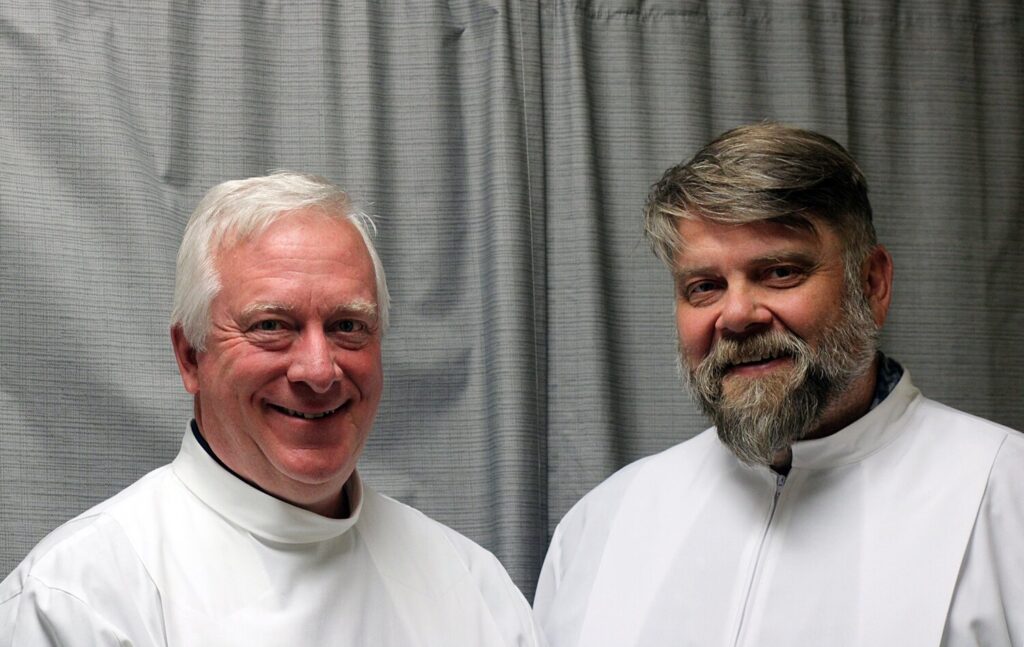
BROOKINGS A bit of local history albeit religious in nature will be made at 11 a.m. today at St. Joseph Cathedral in the Catholic Diocese of Sioux Falls, when for the first time two Brookings men from St. Thomas More Catholic Church were ordained permanent deacons. Bishop Donald DeGrood presided over the ceremony.
The day was one for which Philip Carlson and Brad Wiemann, with a spirit of discernment, had been studying and preparing spiritually over the past four years. Meanwhile, Wade Wontoch, also a member of St. Thomas More, is entering his second year of what is now a five-year program.
The permanent diaconate is open to married men, whose wives must be part of the program. Carlson and Wiemann are both married and have children and grandchildren. Wontoch is not married. All three men are converts to Catholicism and entered the Catholic Church via the Rite of Christian Initiation for Adults program.
At a time in the history of the Catholic Church when there is a severe shortage of priests, deacons are stepping up to help fill some of the gap. What deacons can do is described simply by Deacon John Devlin: Deacons are ordained for service to their bishop. Deacons can baptize and can witness marriage vows, but they cannot administer the other sacraments that priests can.
Mission is service
Probably from high school on, (I had) this desire to serve, said Carlson, 58, a native of Rosholt. I participated in the student council.
Following high school, he started college at Augustana and finished at the University of South Dakota. He earned an ROTC scholarship and went on to serve for about 10 years as an infantry officer in the United States Army.
Carlson and his wife Pam have been married for 39 years and have two children and four grandchildren. He saw himself on what he calls a winding road of being baptized, confirmed Lutheran and coming back to the Church. A Cursillo (a Spanish word that translates to a short course in Christianity) answered that for me.
In 2013, he first gave some thought to pursuing the permanent diaconate. Deacon Roger Heidt, of the Sioux Falls Catholic Diocese, visited Carlson and his wife Pam; both husband and wife would have to journey through the program together.
He (Heidt) laid it all out; he showed us how it was going to work, Carlson explained. It was 100 percent clear that this was not the right time. Pam had just gotten her masters degree; wed just gotten both daughters married to wonderful sons-in-laws; and she was exhausted, not ready to take on anything else. I totally understood that. Then fast-forward to 2020.
He attended a presentation by Dr. Chris Burgwald, a theologian in the Sioux Falls Diocese, in the social hall at St. Thomas More. Sitting at Carlsons table were two permanent deacons and two priests, one of them being Father Terry Anderson of St. Thomas More.
Burgwalds first topic was the diaconate: What does a deacon do? At the first break, Anderson asked Carlson, Have you ever thought of being a deacon?
Carlson made a joke about having a wingman if he decided to apply for the program. Wiemann became that wingman.
At that point, Pam was all in, Carlson said. She filled out eight pages for our application. We got the application in and then COVID came along. We had no idea when anything was going to open up again. But that Lent is one of the most memorable ones of our lives. We did a lot of praying.
Following the reopening of the Sioux Falls diocese in May 2020, Carlson was accepted into the diaconate program in August.
Our mission is service, Carlson explained. And how that plays out can differ from deacon to deacon. For some, their mission is to be at the Minnehaha County Jail; and they do that as a couple.
For me, the Knights of Columbus fits right in with that. Its very humbling to be able to work with brothers up and down the diocese.
Phil said it very well, Wontoch noted. Its about service: serving our Lord, serving the diocese and the bishop; serving our brothers and sisters in our faith.
Witnessing and invites
Brad Wiemann, 61, and Shelly Wiemann have been married for 40 years. In the jargon of the older Catholic Church, they started out in a mixed marriage. Today they have three children and three grandchildren.
He was born in Chamberlain and grew up in Webster, raised as a Lutheran in a family of six kids. He and Shelly married in college (at South Dakota State University), started having a family, lived down in Iowa and moved back to Brookings to be with Daktronics in December of 93. At SDSU he had earned a bachelors degree; he then earned a masters degree in electrical and computer engineering at the University of Iowa (Iowa City).
When he and his wife married, she was a Catholic and he remained a Lutheran. Our kids were raised Catholic, he said. Laughing heartily, he added, They went to Catholic church, then they went to Lutheran Sunday school.
After the move to Brookings, the family became part of St. Thomas More Catholic Parish. Several parishioners, including Sister Marlene Minneart, OSB, approached Wiemann and invited him to further participate in such parish roles as lector and usher and were surprised to find out he was not a Catholic, having seen him regularly at Sunday Mass with his family. Wiemann credits witnessing and invites for his conversion to Catholicism and then to the diaconate.
Sister Marlene sort of grabbed (him) by the ear and said, Its time. He completed the RCIA program and came into the Church in 1999. He later became a lector and lay Eucharistic minister.
However, his career at Daktronics over the next seven to eight years demanded a lot of travel, including internationally. But later he began to frequently attend, with Shelly, daily Mass in addition to Sunday. And many witnesses made a big impact on (his) life.
As to the invite to the diaconate, Wiemann referenced a quote of Pope Benedict XVI: God comes to people through people. He always comes to people through other people.
He explained that about 2015, the late Barb Nelson, a St. Thomas More parishioner, kept coming up to me and saying, You ought to be a deacon. And I said, Oh, thats interesting. Whats a deacon? And she was persistent. She kept inviting. And I said, Yes, Ill put in an application.
He did; but the first time around the quota for applicants was filled. He waited and second time around made the cut for what was then a four-year program.
It was a call to a deeper faith, my own faith, he explained. The four years have been a discernment process. Is this God calling me and how do I respond?
Where God wants me
Wade Wontoch, 59, grew up without any religious foundation: We did not attend any church. He served in the United States Army in a cavalry unit for about 10 years, some of that time spent abroad in Germany. During that time, I was exposed to a lot of different beliefs and religions, he explained. Some of which I dabbled in but none of them filled that hole, if you will.
Following his military service, Wontoch attended college at a very liberal university at which (he) got a very good education. But it didnt help (him) spiritually. Years later he would attend a non-denominational Cursillo. He came away from that with a kind of epiphany, a spiritual awakening.
He began looking at local churches in the Brookings area: If Im going to serve the Lord, part of that is being part of a church, not in a physical sense but in a body of believers. But none of these local churches filled that hole in me, in my spirit.
Then some family members suggested that he speak with a Catholic priest. That led him to St. Thomas More where he spoke with Father Terry Anderson, the pastor; he gave Wontoch some books and videos, which he read and watched.
Wontoch followed that with the 9-month-long RCIA program. He firmly knew that the Catholic faith was where (he) wanted to be. He entered the Church during the Easter Vigil of 2021 at St. Thomas More.
He knew that Carlson and Wiemann were studying for the diaconate; he additionally visited with Deacon John Devlin of the Sioux Falls Diocese and began a process of daily prayer, readings and discernment. And he spoke with Anderson and continues discernment a vital element as he completes the first year of the five-year program that leads to ordination.
I feel called to it, Wontoch said, as his journey to ordination continues. I will dedicate my life to God; and where he wants me to go, I will go.
Contact John Kubal at [email protected].
Leave a Reply