
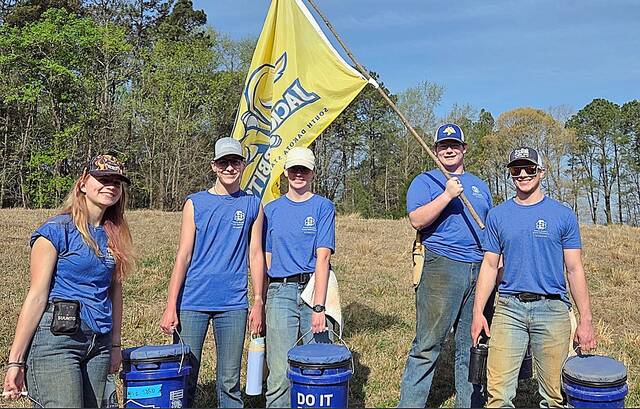
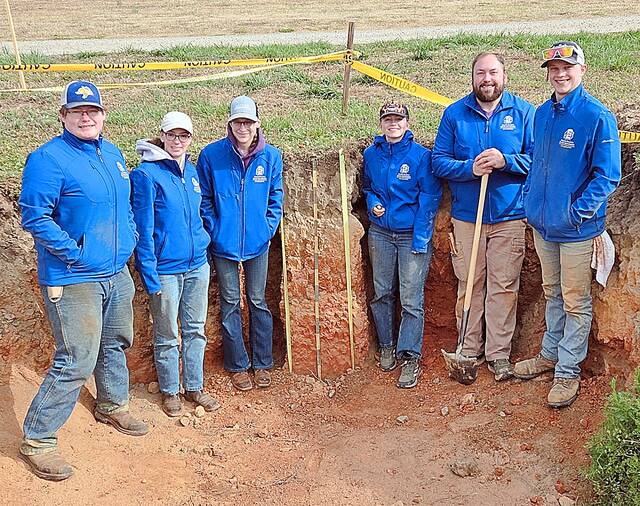
BROOKINGS — The South Dakota State University Soil Judging Team returned from the National Collegiate Soils Contest in Raleigh, North Carolina, with strong results. Competing against 28 universities and more than 300 students to properly identify and characterize regional soils, SDSU secured a 20th overall finish and a 14th-place ranking in the team judging category.
This marked SDSU’s first national qualification since coach Kristopher Osterloh, assistant professor of soils and pedology in the Department of Agronomy, Horticulture and Plant Science, joined the program in 2019. The trip was following the team’s fall 2025 regional championship, its fourth regional win since the 1980s.
Veteran team member Luke Desmith concluded his collegiate career with a 20th-place individual finish out of more than 112 official competitors. He also earned first-place individual honors at the regional competition.
Soil judging contests test students on skills used by professional soil scientists. Teams evaluate soils based on morphology, land site description, hydrologic characteristics, taxonomy and site interpretation for specific land uses. Unlike many contests, teams spend a few days practicing on regional soils before the contest begins.
“It’s a way to learn and train on how to describe the soil,” Osterloh said. “It’s not just a test of the skills that we can do here, but it’s actually going out there to learn and experience something totally new and different.”
To succeed at the national contest, co-sponsored by the Soil Science Society of America and the American Society of Agronomy, the team had to adjust to soil conditions very different from South Dakota. They encountered high-clay soils that felt “soft and buttery” and learned to identify “glittery” micaceous sands that lacked the typical sandy texture. They also worked with “tiger-stripe” plinthite, an iron stone that irreversibly hardens once dried. Osterloh brought back a tote of soil samples from the contest for future teams to study.
The team’s success at nationals was from weeks of preparation. Members studied regional soil systems using maps and books to understand the soil types they would be working with. A key component of the their training involved guidebook skill checks, where they practiced applying contest rules.
“We will take a soil from that region and then fill in that morphology part, the actual soil,” Osterloh said. “Then they get to practice the guidebook and go through all those skills, like telling you what the water capacity is based off of the texture.”
The team spent time practicing soil texture using lab samples, adjusting them to resemble soils from North Carolina. They also studied geologic maps and rock samples from Osterloh’s collection to better understand what they would see in the field.
Once in North Carolina, the team completed four days of field practice near Raleigh, rotating through multiple soil pits and applying their training in real conditions. This experience helped the team adjust to the new soils and enter the contest prepared. Along with technical preparation, teamwork also played a major role in the team’s success.
The team is made up of students from a range of majors, including agronomy, biochemistry, engineering and agricultural education, allowing them to draw on each other’s strengths throughout the contest. Beyond the contest itself, Osterloh praised the team’s camaraderie.
“Everyone learned a lot and worked well as a team,” he said. “You have to learn to trust each other’s input and come to a decision together because you’ve got one scorecard.”
Osterloh describes soil judging as a “miniature version of professional soil science work,” giving students practical, on-the-job skills. For the agricultural education majors on the team, soil judging offers training on how to teach land judging to future FFA students.
“It’s one of the few classes where you really get to take your classroom knowledge and apply it in the field,” Osterloh said. “Like an internship where you’re going outside and doing something rather than just learning about it.”
The experience at nationals taught the students how to think quickly and be adaptable, skills needed in professional settings. Moving from familiar South Dakota soils to entirely new soil systems required students to rely on their training while making quick adjustments in the field.
“They’re also practicing the ability to go somewhere new with a base understanding and absorb new information,” Osterloh said. “You get shoved 1,000 miles away, and you kind of know your soils, but now here’s a totally new soil. You have to absorb all that information really quickly and make adjustments.”
The SDSU Soil Judging Team welcomes students from any major or experience level who want to learn outside and “touch dirt.”
“We’re trying to get more people to come out, and most people who do it say I wish I would have joined sooner,” Osterloh said.
Leave a Reply