
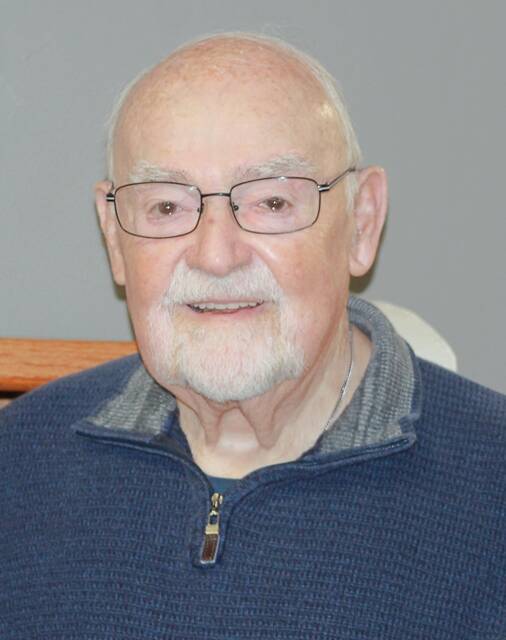
BROOKINGS — In 2016, Brookings resident Dr. Robert “Bob” Burns, a noted and respected political scientist and educator, was inducted into the South Dakota Hall of Fame. Some of his “Legacy of Achievement” cited on that ceremonial occasion is noted below, but at 83 and well into his retirement, he continues the sort of dedicated work that led to his selection and induction into the hall.
Burns was born in Flandreau in 1942. Growing up there at the same time was William “Bill” Janklow, who was three years older than him; he would go on to be four-term governor of South Dakota. “I got to know him when his mother moved the family back to South Dakota (from Chicago) following his father’s death,” Burns recalled.
“Over the years I got to know Bill more and more and his siblings. He was always very good to me. He was always complimentary and supportive. I worked a couple summers out in Pierre in his administration, largely dealing with the executive branch and organization. I was part of the reorganization staff. I had some good foundational knowledge of state executive branch organization.”
Mid-summer following graduation from Flandreau High School in 1960, Burns was ready to attend the University of South Dakota when he received a letter from South Dakota State University advising him that he had been chosen for a four-year Briggs Scholarship because one of its recipients had declined.
“I had a change of mind. I guess I followed the money,” he said, smiling. “The Briggs Scholarship was much more substantial. In fact, it was for $500. It covered 50 percent of the costs for my freshman year, which was roughly $1,000.”
He would go on to earn a bachelor’s degree in political science, graduating in June 1964. And having completed four years of Army ROTC, he was commissioned a second lieutenant. Prior to both those rites of passage, he married Donna Bozied in the spring.
Burns would go on to earn a master’s degree in 1966 and a doctorate in 1973, both in political science, from the University of Missouri (Columbia). Along the way, however, he did a two-year tour of duty as an officer in the U.S. Army, from 1968 to 1970. He would serve 11 months in Vietnam.
While he was initially trained at Fort Benning, Ga., as an infantry officer, Burns would transfer to military intelligence and serve as a “senior intelligence officer” in the Mekong Delta from September 1969 to August 1970. He attained the rank of captain and was awarded the Bronze Star for Meritorious Service and the Air Medal with Oak Leaf Cluster.
Signs on for one year, stays for 38
While serving in Vietnam, Burns was made an offer that turned out to be life-changing: an SDSU undergraduate mentor, Professor JP Hendrickson offered him a one-year teaching appointment. “I was very quick to accept that kind offer,” Burns said. Laughing, he added, “That one-year appointment evolved into 38 years.”
“We were a very small department,” Burns said. “We taught a variety of courses. I taught American Government; American Political Issues; Constitutional Law; Civil Rights and Liberties; Administrative Law; School Law; Canadian Politics; and the Politics of China and Asia.
“Everybody had a fairly heavy teaching load and taught a variety of courses because of how small the department was,” he noted. At that time the Political Science Department was under the umbrella of the College of Arts and Sciences.
Burns would go on to serve as department head of Political Science, Philosophy, History, and Religion. Add to all his SDSU duties a brief stint at USD in 1998 “to set up a new leadership program on civic leadership; the Farber Center is a popular name for it.”
Back to SDSU and retirement
While he was at USD, the new SDSU president, Peggy Gordon Miller, invited him to come back “in a leadership role to transform the small honors program into a full-blown Honors College.” He would go on to serve as its first director and then as its first dean.
Burns would during his 38-year tenure at SDSU receive multiple education and teaching awards, including seven different years being named “Teacher of the Year” for the College of Arts and Sciences.
Upon his retirement in 2008, the South Dakota Board of Regents honored him with the title of Professor Emeritus of Political Science and Dean Emeritus of the SDSU Honors College. Additionally, the SDSU Alumni Association in 2008 honored him as an SDSU Distinguished Alumnus for Service to Education.
In retirement, Burns and several other colleagues started the SD Budget and Policy Institute, which he chaired for about 10 years. Additionally, he was one of the charter members of the SD World Affairs Council and would go on to chair the council, which periodically brought in delegates of young professionals from such nations as Russia, Ukraine, and Mongolia.
“All of them were very worthwhile activities,” Burns said. “All of those dealt with the role of civil society in a democracy. Brookings is a wonderful community to illustrate that because we have so many active civic volunteer organizations here.”
One of the Council’s major annual undertakings is “the hosting of China Town Hall, in cooperation with the National Committee on U.S.-China Relations.”
Bob and Donna Burns have three adult children and spouses, 11 grandchildren and two great-grandchildren.
— Contact John Kubal at [email protected].


Leave a Reply