
By Mondell Keck | The Brookings Register
BROOKINGS — Sequitor Edge’s hopes for a city sales tax rebate that’s linked to its proposed small-scale data center project in Brookings was rejected at the City Council meeting on Feb. 24.
The 7-0 vote against granting the rebate, valued at $644,280, wasn’t a rebuke against the overall project — something emphasized by several councilors. Rather, their opposition to the incentive at this time centered on concerns tied to power and water usage along with environmental worries, such as where e-waste would go, and noise levels.
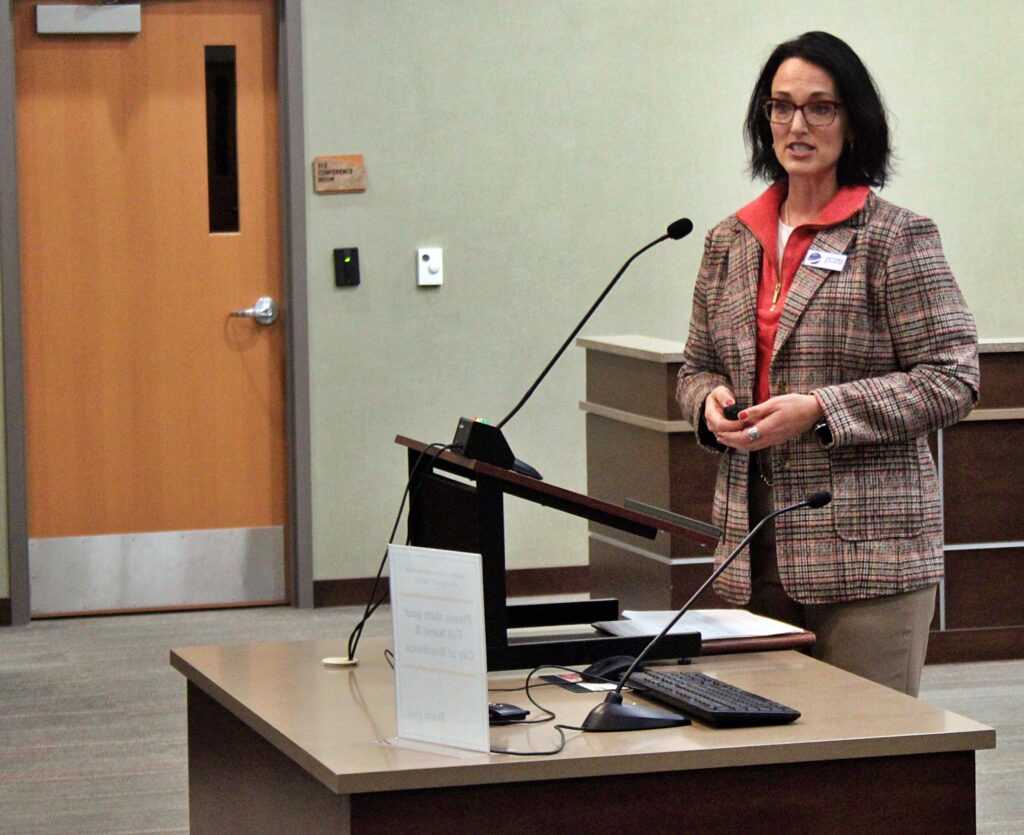
PHOTO CAPTION
Sequitor Edge’s Victoria Blatchford makes her case for a sales tax rebate linked to a data center project in the SDSU Research Park at the Brookings City Council meeting on Feb. 24. (Mondell Keck/Brookings Register)
Plans for the proposed project in the Research Park at SDSU involve renovating and expanding the building at 2324 Research Park Way that formerly housed Discovery Benefits. The facility has been vacant for five years, and Sequitor Edge’s efforts would represent more than $41 million in private investment.
Company representative Victoria Blatchford told councilors that the end result will be a Tier III data center with edge and co-location capabilities serving the data needs of business, education and health care entities in the area. Brookings would serve as the “hub,” or regional headquarters, with “spokes” radiating out to serve Madison, Watertown and Marshall, Minnesota.
“Sequitor Edge, with an edge computing center, we bring the power of a mega into a small operating system that services the local businesses,” Blatchford explained. “Huge difference between mega-scale data centers — or even a general data center — (which) could eat up a 100-megawatt need and serves only a sole purpose. This is going to be serving the Brookings business community.”
Lastly, she described a Tier III data center as very reliable, with 1.6 hours or less of downtime in an entire year.
“When you think about that — with life-saving needs, financial institutions needing to have immediate data available — protection and security for everyone’s data, whether it’s personal, professional or financial, you need to have that hyper secure, hyper personalized service and know that your downtime is going to be almost zero,” Blatchford said.
She then brought up an example of a growing local business — in this case, Falcon Plastics — that is facing the challenge of possibly having to move its technical services to a site outside of Brookings. That’s because local resources via Swiftel Communications are no longer able to meet Falcon’s needs because they’re above and beyond Swiftel’s support capability for power and capacity.
“Sequitor Edge will help keep our Brookings technology here — those services, which is sales tax dollars to you, and to support our community growth. … It’s an economic development catalyst for the right type of business,” Blatchford pitched.
Data points
Her information also included other numbers and insights related to center:
• It would initially use two megawatts of power, with a gradual buildup of up to a maximum of 10 megawatts in the years ahead.
Blatchford said Brookings Municipal Utilities has worked with Sequitor for nearly a year now. A distribution study showed no concerns, nor are there any preliminary worries from a nearly completed transmission study.
• A one-time water fill of 19,000 to 20,000 gallons would be needed for its closed-loop cooling system. Water use thereafter would be no more than a normal office on a daily basis.
“We only have to fill it one time,” Blatchford explained. “Because of a propriety design, we are extremely energy efficient and we are extremely water efficient as well.”
It was also noted that a similar process would be necessary for other modules that would come online over time.
• The Brookings facility would not be a hyperscale cloud campus or a massive data center complex, nor would it be a cryptocurrency mining operation.
• The proposal’s success hinges on Sequitor Edge being able to negotiate a lease with an option to buy the currently state-owned land, which encompasses more than five acres. It will be on the agenda at the South Dakota Board of Regents meeting on April 1-2.
• Noise levels will be comparable to existing manufacturing facilities in Brookings, primarily from chillers and backup generators, and will comply with local noise standards. That’s important, as some residential structures are within 1,000 feet of the proposed data center.
Blatchford said mitigation efforts would include special, enhanced walls and the use of foliage.
• Sequitor Edge is also working with the Governor’s Office of Economic Development with the goal of qualifying for tax rebates through GOED’s Reinvestment Payment Program. It provides a refund of South Dakota sales and use taxes paid on eligible projects, generally for investments over $20 million or $2 million in equipment.
“Your funds and theirs combined will help us be able to purchase the property,” Blatchford told councilors prior to their vote on the incentive.
• The goal is to have the data center operational by the second quarter of 2027.
Public’s thoughts
Following Blatchford’s presentation — she was accompanied by Stephanie Mason with the Brookings Regional Growth Alliance as well — Aurora resident Craig Jorgensen stepped up to the mic with some concerns. He said he’s an SDSU graduate with a degree in computer science and worked for years as a cybersecurity analyst and as an IT service provider.
Jorgensen said that while he recognizes the need and value for data centers like the one proposed for Brookings, he wants the community to consider potential ramifications when considering the sales tax rebate.
He pointed out that closed-loop systems are a category of cooling systems. They encompass a variety of cooling systems, and how they leverage water can differ.
“I would be very interested to see how this particular center would be using its water system,” Jorgensen said. “Closed-loop systems filter water over the CPUs over and over again, but then the cooling and distribution of the heat happens through another system.”
Jorgensen pointed out that the water is often treated with chemicals such as glycol and anti-corrosives, and eventually the wastewater must go somewhere. He’d be interested in seeing what plans Brookings has for when that issue comes up.
For her part, Blatchford said the closed-loop water cooling system cools the air itself, which in turn cools the cabinets, of which there’d be 250 or so in the initial rollout of the Brookings data center.
“That’s a different system (Jorgensen) was talking about,” she said. “Water would not be used directly on any of the cabinets unless — now, we can customize that if there is the high need, there are some GPU servers … that actually (have) to be immersed in water and chemical, (but) at this time I’ve not come across anyone in the Brookings area that needs that kind of immersion cooling system.”
She further pointed out that the cooling system is very environmentally friendly, that there’s no excess waste that gets put out anywhere at any time, and the water usage is clean water.
Jorgensen also looked for some guarantees that the facility’s power costs would not be passed on to local customers.
“We will eventually as a community be subsidizing this project If the costs are eventually passed on to us,” he said.
In closing, Jorgensen concluded, “I do see the value in a project like this, but I do think proceeding with caution is wise.”
Councilors’ thoughts
Leading the way, Councilor Bonny Specker sprinkled her inquiries with some insights, including that, based on the information she found on power consumption in this region of the nation, and confirmed with BMU, that two megawatts would use the same amount of power as that used by 1,440 homes. At 10 megawatts, it would be the power that 7,000 homes use.
“It’s a lot of power, and I have a couple issues with this,” Specker said. “First, I’m concerned that this power usage for the data center may limit the ability of other companies to come here if the power needs cannot be met because of the high demand of the data center.”
A second area of concern rests on the fact that BMU has two sources it buys power from — Western Area Power Administration (WAPA) and Missouri River Energy Services (MRES). Specker said WAPA is cheaper, but that it’s allocated in certain amounts that cannot be increased. Right now, 30% of BMU’s power comes from WAPA.
“Power to use to support this data center will increase the amount of power that BMU will need to purchase from MRES,” she said. “So, a higher percent of the electricity that Brookings will be using will need to come from this more expensive source, and this will lead to an increase in electricity costs to all BMU customers.”
Responding to Specker’s concerns, Blatchford said the aforementioned power transmission study was completed with no concerns from BMU, and that the ongoing power distribution study will help decide the above-and-beyond cost.
“That’s something that we will work with. We don’t expect our community to pay for our electricity by any means,” she said. “That will be a public power agreement if that’s what we need to do.”
Meanwhile, Councilor Wayne Avery pointed to the money the city has already sunk into the Research Park.
“There’s probably no piece of land in the city that’s had more city funds invested than that particular piece,” he said, including $1.9 million in recent sewer system upgrades. “There’s already substantial investment in that property. A lot of everything that you need is there with the streets, the sewer, the water (and) the building.”
Avery finished, “I just don’t know that we can vote for a sales tax rebate because that might be the way we recoup some of those funds.”
Blatchford noted that the sales tax rebate Sequitor Edge is seeking is one time in nature, only for the construction and equipment phase of the project. She added that she thought about pursuing tax increment financing but opted against that because Brookings already has several TIFs.
“With the help of the city’s tax rebate amount, we will be able to help purchase that land,” she said, saying that Research Park land is priced at between $7 and $8 per square foot — well above the roughly $3 or less per square foot price found for land at other Sequitor Edge sites in Rapid City and Kearney, Nebraska.
Councilor Brianna Doran joined the conversation as well.
“I really do have a concern with especially that safeguarding of not having the (power) cost shifting to our residents,” she said. “I understand that an agreement is in the works and you have a timeline on that, but when I look at just the city incentivizing … I would want to have those safeguards in place for our residents before I’m open to that discussion.”
Doran also said she had lingering concerns regarding the proposed center’s environmental sustainability and impact, but also understands that local businesses have needs as well.
Councilor Lisa Hager said the project’s uncertainties troubled her.
“There’s just a lot of uncertainty regarding this project. While there are economic development benefits, I still think it’s difficult to provide incentives … because of some of the sticking points that I’ve mentioned,” she said. “We don’t have everything completely ironed out with respect to utilities and the impact that would have on citizens.”
Mayor Oepke “Ope” Niemeyer noted that while he did vote in favor of the overall project in his role as a member of the board of directors at the SDSU Research Park, he wasn’t sure if he could support the sales tax rebate by itself.
“We don’t have all the answers tonight,” he said. “We don’t have the true numbers that are expected to happen from BMU as far as rates and how they’re going to be affected and how they would be increased in the future and who’s going to pay for that increase — I think there’s some negotiation that probably could be done there.”
Aftermath
In the end, all seven council members voted against the sales tax incentive for Sequitor Edge. While not having its benefit, Blatchford said the project would march forward.
“It didn’t help, that’s for darn sure, but it definitely didn’t defeat it,” she told The Brookings Register. “We’re adamant that we’re going to make it happen because the businesses that are here and the businesses that we want to come to Brookings — based on our economic development master plan — need this type of infrastructure.”
Mason spoke up as well, noting the project’s opportunities for Broookings.
“I think it’s a great project to put forward for the community — it supports a lot of the needs that are here,” she said. “This is a creative opportunity to fill not only existing business needs, but some of those sales tax revenue opportunities as well.”
Those revenues, according to information from Sequitor and based on the 2% city sales tax, would mean $38,000 in 2027. Other years show:
• 2028: $136,000
• 2029: $176,000
• 2030: $196,000
• 2031: $200,000
• 2032: $204,000
Blatchford added that, “For us, as long as we can get that lease agreement with the option to purchase solidified with the (South Dakota) Board of Regents, then we’ll be able to start site control, construction and renovation on it. We would then have to pursue more additional equity to be able to purchase the actual land itself.”
In closing, Councilor Nick Wendell spoke of the message being sent by the City Council’s action.
“I hope the message isn’t that we’re not real business friendly and economic development focused because we absolutely are to the tune of millions of dollars of investments in this exact neighborhood you’re looking to build in,” he said. “I’m just not certain that I believe this project is one that we would incentivize in this particular way.”
— Contact Mondell Keck at [email protected].
Leave a Reply