
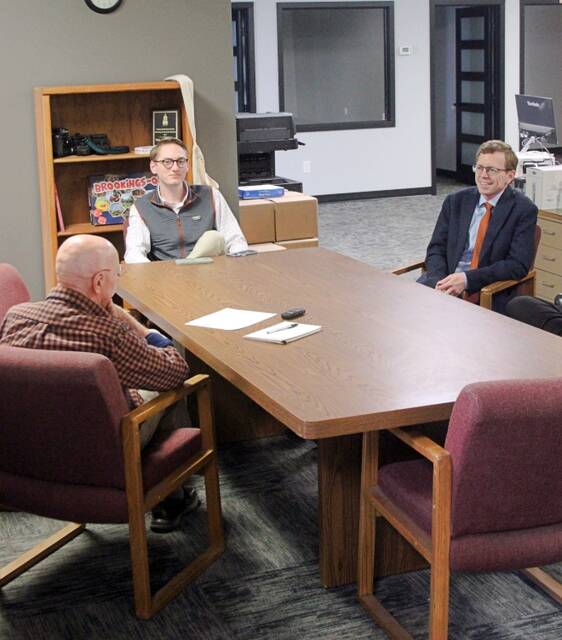
BROOKINGS — Dusty Johnson, South Dakota’s at-large sole member of the United States House of Representatives, was in town Friday afternoon and stopped in at The Brookings Register for a scheduled interview that de facto became two interviews: one tied to his job in our nation’s capital, the other to his candidacy for governor of South Dakota. He tackled the topics noted below put to him in a series of questions.
Any key pieces of legislation he’d like to see enacted into law? “I’ve worked hard to make it so that members of Congress can’t buy or sell individual stocks,” he said. “I believe that we’ll get a vote on that legislation here in the next two months. We should get the skinny Farm Bill done. We passed most of the Farm Bill last year. But there was about 15 percent that we weren’t able to get done as a part of the Reconciliation process. I’m one of the six subcommittee chairmen who drafted the skinny Farm Bill. It came out of committee two weeks ago on a strongly bipartisan basis.
“And obviously we also want to resolve this shutdown with Homeland Security. Shutdowns are stupid, regardless of what party causes them. I think it’s insanely unfair, remarkably unfair for us to do that to the men and women of the Coast Guard, the TSA and all of the other Homeland agencies.”
Weighing in on the Democratic demands for ICE reform in the Department of Homeland Security appropriation measure, Johnson admitted that “some of the demands are reasonable, like body cameras. I’ve been supportive of that policy, long before the Democrats had them as demands. Others of them, like having huge numbers of buildings where ICE agents couldn’t go to arrest an illegal immigrant who’d been accused of a violent crime seems like an overstep to me. But this deal needs to get cut the way all deals need to get cut. People need to grow up, and we need to get the big boys and girls in the room. We need to figure out which demands are reasonable, which are unreasonable, and we need to move forward.”
Continuing and noting an example of how both parties can cooperate, Johnson noted that “all 12 of the appropriations bills came out of the United States House on a strong bipartisan vote –– every single one of them had Democrats and Republicans come together to pass them. Then they got to the Senate; the Democratic senators were willing to agree to 11 out of the 12. But they held up any action on the 12th. Clearly, I think I’ve shown a willingness to find common ground and we successfully did that on funding 96% of the federal government through the end of the fiscal year.”
Queried about the effect of President Trump’s tariffs and the ordered attack on Iran and their potential for harming the economy, Johnson let it be known that he’s “not a fan of high tariffs as a part of the economic landscape. But I think we all understand what President Trump was trying to do, which is to use the threat of high tariffs to try to get better trade deals.”
Continuing, he explained, “We do know that a number of our trading partners don’t treat our country well: Mexico’s tough on American corn; Canada’s tough on American dairy. The president has tried to secure better trade deals. He’s succeeded in part, although I think we would all like to see the pace of success pick up a bit.” He reiterated that he’s “not a fan of high tariffs as a permanent part of the landscape.”
When asked about the War Powers Resolution that would have required subsequent approval of the U.S. House and Senate to continue the attack on Iran and if he believed the president should have the power to wage war without congressional approval, Johnson took a step back for a lesson in history: “When you look at the past, Congress has generously provided the president, as commander-in-chief as outlined in the Constitution, the discretion needed to perform bombing and other missile strikes.”
“I don’t remember my Democratic colleagues objecting when President Obama did it over Kosovo. And in fact, for better or for worse, every American president in my lifetime has felt the need to use American air power to try to make our country safer. Now, clearly the Democratic objections with President Trump are much hotter than any objections they have had any other time that a president has used that power.”
Planning for Pierre
In the second interview, the topics were shifted from what he’s doing in the nation’s capital as South Dakota’s sole member of the House of Representatives to what he would do in Pierre as governor of South Dakota and some of the executive and leadership skills needed for that job.
He fielded questions on: public education, the state’s prison system, and the SAVE (Save American Voter Eligibility) Act, which he supports.
“Our four-year and two-year colleges are some of the strongest assets of our state,” Johnson said. “I’ve made it clear as governor that I’m going to continue to invest in them. But it’s not going to be a blank check. I’ve got one son attending college in South Dakota and another one who will be joining him in the fall. College affordability is top of mind for our family, I can tell you. What we want to do is make sure that our colleges focus on things that they do well. We want to make sure that they are preparing students for real careers, careers that will give them the kind of wage that will let them raise a family and realize their dreams.
“There are gubernatorial candidates in this race talking about cutting support to higher education. That’s not something I can support.”
Asked about his position on charter schools in our state, the congressman responded: “I’m very much a fan of educational innovation and reform. I think South Dakota lags behind much of the rest of the country on that front. We have seen Mississippi go from 48th to eighth in reading scores, and they did that by a far bigger investment in phonics, and the science of reading and literacy than our state has made. Our state is clearly lagging behind. One thing as governor that I’ll do is make sure that we are catching up and implementing the best practices that we’re seeing from some of these other states.
“School districts are doing this as well. Wichita Falls, Texas, has taken a great leap forward. I’m going to be open to anything that improves student outcomes. If that means investing in phonics, I’m for it. If that means investing in charter schools, I’m for it. I’m not so focused about what the delivery system looks like; I’m interested in whether or not our kids are learning.”
Tied to the issue of the planned new $650 million prison, Johnson was asked if he had specific proposals for prisoner rehabilitation programs, some of them suggesting that our high recidivism rate could not be reduced if rehabilitation programs failed.
“I was pretty disappointed in the governor and the Legislature,” the congressman said. “They promised when they voted to build this new prison that we weren’t just going to fill it up again. We were going to do things differently. We were going to find a way to find offenders accountable and make them less likely to reoffend. Unfortunately, this year in the legislative session, they killed the funding package that would have invested in new rehabilitation programs. They’re just not making good on their commitment.
“As governor, I’ll understand that it’s going to be really important to catch people who break the rules, to hold them accountable but also to make sure that they’re ready for reentry when that time comes. That is going to mean far better substance abuse treatment inside the walls. It’s going to mean better job and educational training inside the walls. It’s going to mean helping these people with some of the mental health issues they’ve been struggling with.”
Weighing in on the SAVE Act, Johnson noted that the Constitution “allows us to set some minimum standards for federal elections. I think South Dakota’s elections are very well run. And a lot of what the SAVE Act, which I have been a strong supporter of, does is just put into place in the rest of the country the kinds of protections we have in South Dakota: which is that non-citizens don’t vote and make sure that voters show a photo ID on election day. The reality is that a photo ID is a basic necessity of modern-day life: you can’t pick up SDSU tickets at will call, or check into a hotel room, or buy a six-pack of beer or get onto an airplane without an ID.
“I find it insulting that some of my Democratic colleagues have insinuated that women and people of color can’t navigate the photo ID (system). They do every single day. In South Dakota, I think we’ve found for decades that the system is very workable.”
— Contact John Kubal at [email protected].
Leave a Reply